We develop advanced heterogenous catalytic systems for the sustainable production of synthetic fuels and commodity chemicals. The ECSGroup team uses an interdisciplinary approach combining the most novel synthetic methods for the fabrication of robust metal-supported catalysts, reaction engineering and fluid-dynamic simulations to boost the efficiency of these processes.
We focus on relevant reactions for renewable fuel production, such as CO₂ hydrogenation, biogas reforming, ammonia synthesis and cracking. Our research also involves process intensification via combination with membranes or aided by chemical looping schemes and the incorporation of electrified systems such as reactions driven by microwave radiation. In addition, in situ and operando spectroscopies and kinetic modelling are employed to discern the underlying mechanisms governing these reactions.
Selected results
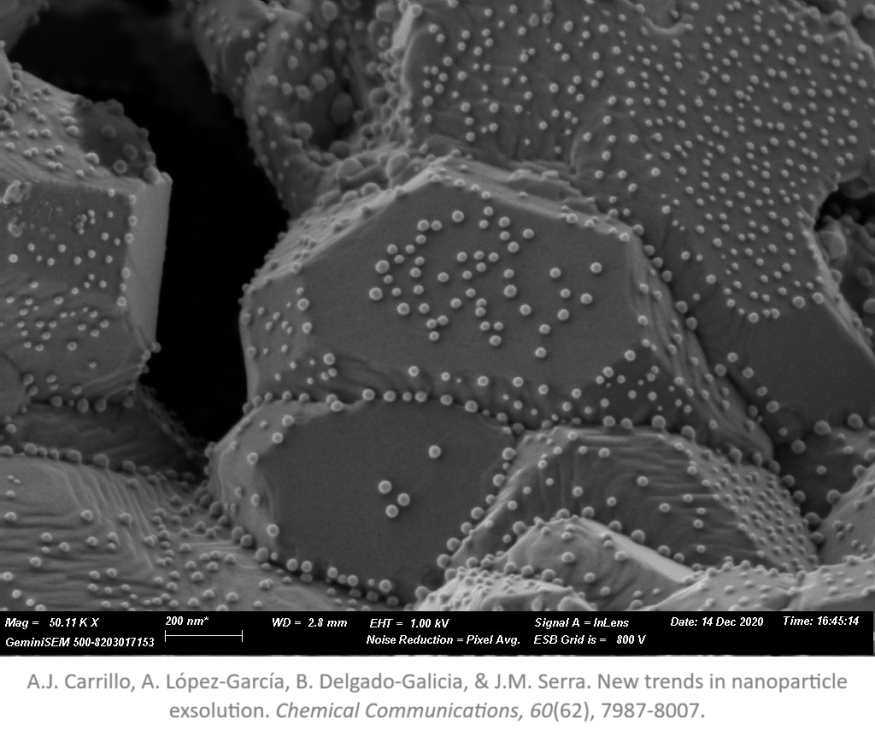
New trends in nanoparticle exsolution. (2024). A.J. Carrillo, A. López-García, B. Delgado-Galicia, & J.M. Serra. Chemical Communications, 60(62), 7987-8007. https://doi.org/10.1039/D4CC01983K
Microwave-Driven Exsolution of Ni Nanoparticles in A-Site Deficient Perovskites. (2023). A. López-García, A. Domínguez-Saldaña, A. J. Carrillo, L. Navarrete, M. I. Valls, B. García-Baños, P. J. Plaza-Gonzalez, J. M. Catala-Civera & J. M. Serra. ACS Nano, 17(23), 23955-23964. https://doi.org/10.1021/acsnano.3c08534
Ni-sepiolite and Ni-todorokite as efficient CO₂ methanation catalysts: Mechanistic insight by operando DRIFTS. (2020). C. Cerdá-Moreno, A. Chica, S. Keller b, C. Rautenberg, U. Bentrup. Applied Catalysis B: Environmental 264, 118546. https://doi.org/10.1016/j.apcatb.2019.118546
2. Catalytic Membrane Reactors
Catalytic membrane reactors integrate chemical reactions with membrane separation technology, providing compact systems with improved performance, including enhanced selectivities and yields. We focus on designing advanced membrane reactors and catalysts and testing their performance and long-term stability for the next generation of renewable fuel and chemicals production. These reactors will significantly impact industry and energy decarbonisation by enabling CO₂ hydrogenation to chemicals, fuels or plastics precursors and ammonia synthesis.
Selected results
Direct electrocatalytic CO₂ reduction in a pressurised tubular protonic membrane reactor. (2023). I. Quina, L. Almar, D. Catalán-Martínez, A. Masoud Dayaghi, A. Martínez, T. Norby, S. Escolástico & J. M. Serra. Chem catalysis 3(10), 100766. https://doi.org/10.1016/j.checat.2023.100766
Single-step hydrogen production from NH₃, CH₄ and biogas in stacked proton ceramic reactors. (2022). D. Clark, M. Budd, I. Yuste-Tirados, D. Beeaff, S. Aamodt, K. Nguyen, L. Ansaloni, T. Peters, P. K. Vestre, D. K. Pappas, M. I. Valls, S. Remiro-Buenamañana, T. Norby, T. S. Bjørheim, J. M. Serra & C. Kjølseth. Science 376(6591), 390-393. https://doi.org/10.1126/science.abj3951
Direct conversion of methane to aromatics in a catalytic co-ionic membrane reactor. (2016). S.H. Morejudo, R. Zanón, S. Escolástico, I. Yuste-Tirados, H. Malerød-Fjeld, P.K. Vestre, W.G. Coors, A. Martínez, T. Norby, J. M. Serra & C. Kjølseth. Science 353, 563-566. https://doi.org/10.1126/science.aag0274
3. Electrochemical conversion & Storage
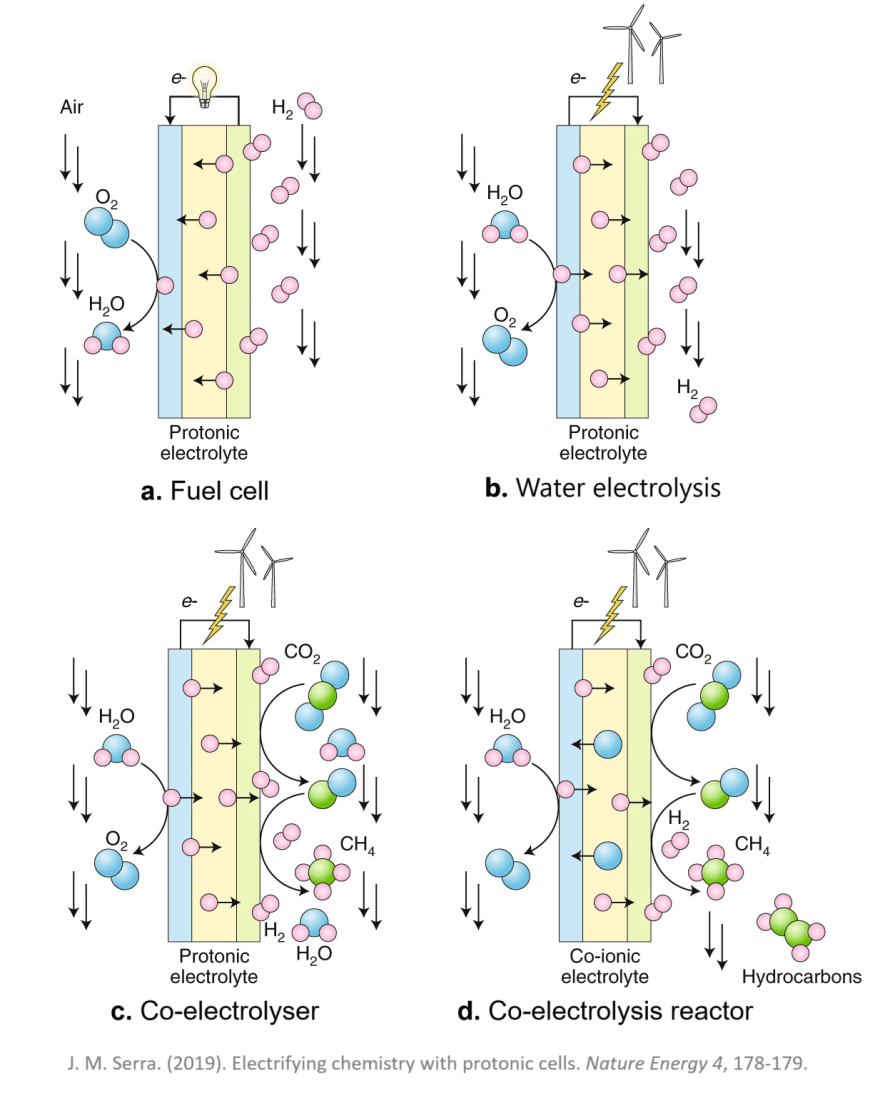
Solid oxide fuel cells (SOFCs) and electrolyser cells (SOECs) are high-temperature electrochemical devices that convert chemical energy into electrical energy and vice versa using solid oxide electrolytes. SOFCs generate electricity by oxidising a fuel at the anode and reducing an oxidant at the cathode, while SOECs perform the reverse process, electrolysing water into hydrogen and oxygen. Protonic ceramic fuel cells (PCFCs) and electrolyser cells (PCECs) are similar but use proton-conducting ceramic electrolytes, offering advantages like lower operating temperatures and potentially higher efficiency.
Research in this field focuses on enhancing the efficiency, reliability, and cost-effectiveness of fuel cells and electrolyser cells. This involves optimising materials and fabrication techniques, understanding and improving electrochemical processes, and developing advanced characterisation methods. The ultimate goal is to make these devices more competitive with conventional energy sources, enabling their widespread adoption in stationary and mobile applications for clean and sustainable energy production and storage.
Selected results
Mixed Proton and Electron Conducting Double Perovskite Anodes for Stable and Efficient Tubular Proton Ceramic Electrolysers. (2019). E. Vøllestad, R. Strandbakke, M. Tarach, D. Catalán-Martínez, M. L. Fontaine, D. Beeaff, D. R. Clark, J. M. Serra, & T. Norby. Nature Materials 18(7), 752-759. https://doi.org/10.1038/s41563-019-0388-2
Thermo-electrochemical production of compressed hydrogen from methane with near-zero energy loss. (2017). H. Malerød-Fjeld, D. R. Clark, I. Yuste-Tirados, R. Zanón, D. Catalán-Martínez, D. Beeaff, S. H. Morejudo, P. K. Vestre, T. Norby, R. Haugsrud, J. M. Serra & C. Kjølseth. Nature Energy 2, 923-931. https://doi.org/10.1038/s41560-017-0029-4
4. Process Simulation & Optimisation
With the intensification of chemical processes, we employ engineering tools to obtain substantially cleaner, safer, and more sustainable technologies. We focus on designing, simulating, and optimising novel processes and units with increased energy efficiency.
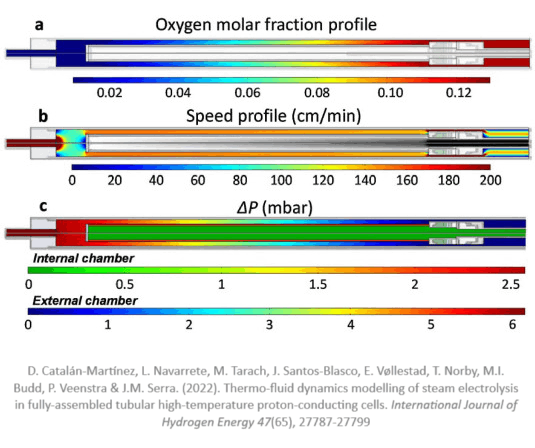
Finite element methodology allows us to study the internal performance of the different reactive units. It helps us optimise all the coupled phenomena guiding the operation until the yield is maximised.
Tecno-economic studies of the new chemical plants, based on these advanced technologies, offer a clear understanding of the economic potential of the process. This knowledge allows for a comprehensive comparison with conventional and established processes, providing valuable insights into the maturity of the technology.
Selected results
Thermo-fluid dynamics modelling of steam electrolysis in fully-assembled tubular high-temperature proton-conducting cells. (2022). D. Catalán-Martínez, L. Navarrete, M. Tarach, J. Santos-Blasco, E. Vøllestad, T. Norby, M.I. Budd, P. Veenstra & J.M. Serra. International Journal of Hydrogen Energy 47(65), 27787-27799. https://doi.org/10.1016/j.ijhydene.2022.06.112
Hydrogen production via microwave-induced water splitting at low temperature. (2020). J. M. Serra, J. F. Borrás-Morell, B. García-Baños, M. Balaguer, P. Plaza-González, J. Santos-Blasco, D. Catalán-Martínez, L. Navarrete & J.M. Catalá-Civera. Nature Energy 5, 910-919. https://doi.org/10.1038/s41560-020-00720-6
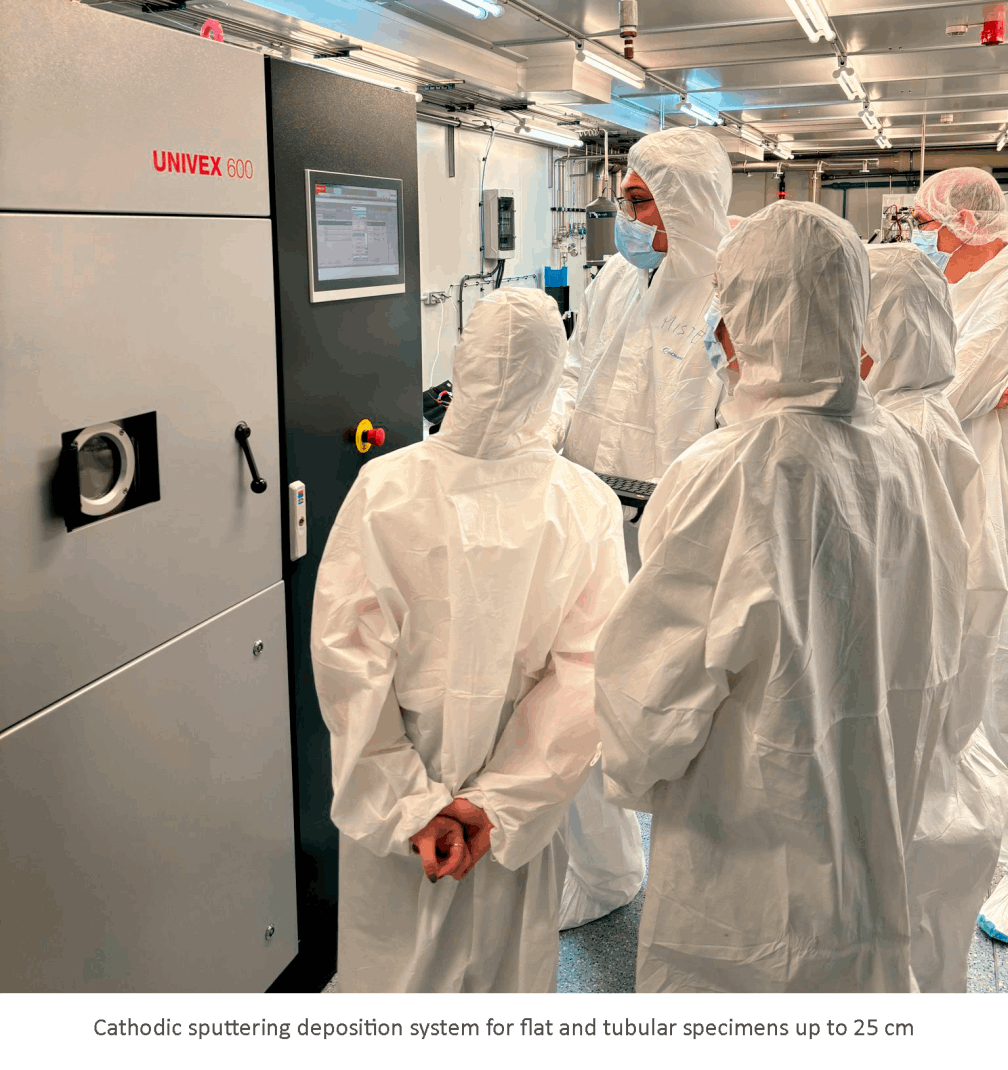
The group has extensive knowledge of producing and characterising mixed ionic-electronic and proton-conducting membranes at bench and prototype scales. Fabrication of electrochemical cells requires several techniques depending on the layer involved and the layer acting as a support. The group has expertise in manufacturing techniques like tape-casting, pressing, freeze-casting, spray-coating, physical vapour deposition, ink-jet, screen-printing, etc. These techniques are employed to manufacture not only cells for bench testing but also for prototyping. The latest implies scaling up the cell size -fabricating up to 10x10 cm- or preparing non-conventional cells.
The electrochemical characterisation of cells requires adequate membrane reactors. The group also has experience designing a balance of plants and customised reactors for testing. Customising reactors provides flexibility, allowing measuring both lab scale and scale-up samples. This implies that the design of electrochemical reactors should be adapted to the size, geometry, and particularities of the cell/reaction and the selection of suitable materials. Reactor feasibility is checked before fabrication with simulations (COMSOL) to ensure adequate gas flows, contact time and current application.
Selected results
Copper surface-alloying of H₂-permeable Pd-based membrane for integration in Fischer–Tropsch synthesis reactors. (2021). S. Escorihuela, F. Toldra-Reig, S. Escolástico, R. Murciano, A. Martínez & J. M. Serra. Journal of Membrane Science 619, 118516. https://doi.org/10.1016/j.memsci.2020.118516
Progress in Ce₀.₈Gd₀.₂O₂−δ protective layers for improving the CO₂ stability of Ba₀.₅Sr₀.₅Co₀.₈Fe₀.₂O₃−δ O₂- transport membranes. (2020). C. Solís, M. Balaguer, J. García-Fayos, E. Palafox & J. M. Serra. Sustainable Energy & Fuel 4(7), 3747-3752. https://doi.org/10.1039/D0SE00324G
Mixed Ionic–Electronic Conduction in NiFe₂O₄–Ce₀.₈Gd₀.₂O₂−δ Nanocomposite Thin Films for Oxygen Separation. (2018). C. Solís, F. Toldra-Reig, M. Balaguer, S. Somacescu, J. Garcia-Fayos, E. Palafo & J. M. Serra. ChemSusChem 11(16), 2818-2827. https://doi.org/10.1002/cssc.201800420